
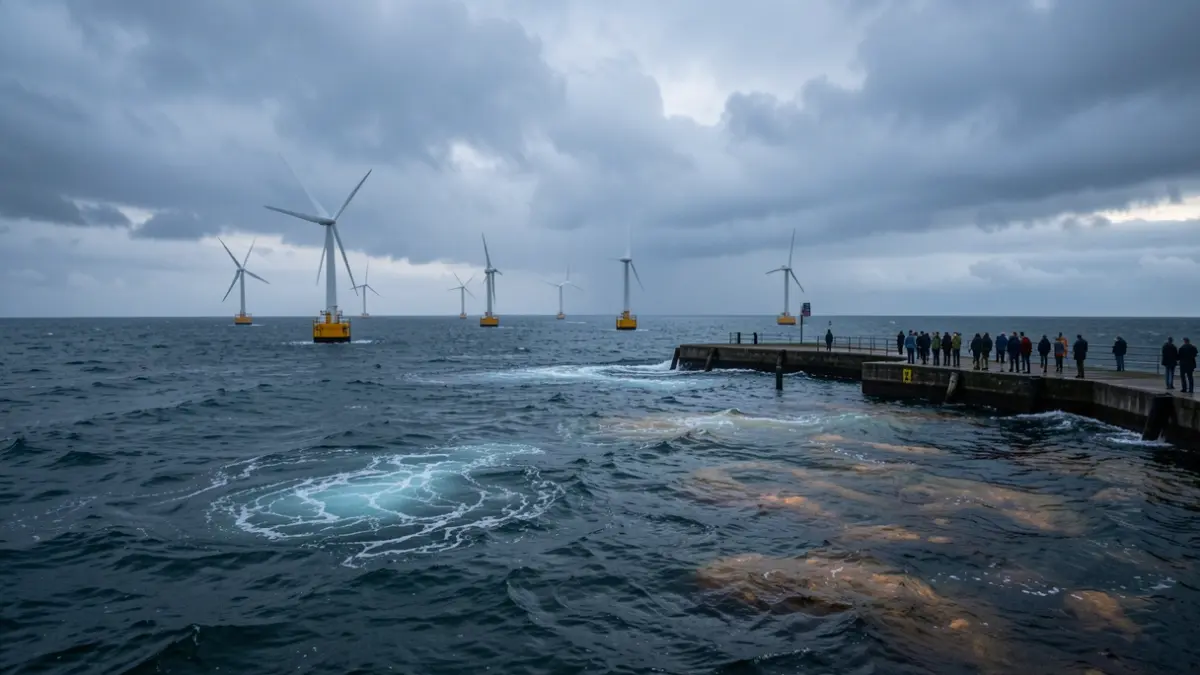
New research from the PELAgIO project, involving scientists from the University of Aberdeen and the National Oceanography Centre (NOC), has revealed that offshore wind farms can alter ocean temperatures and mixing. The study highlights that the extent of these changes is significantly influenced by the surrounding marine environment.
As offshore wind farms become a more significant part of the UK's renewable energy strategy, understanding their interaction with the marine ecosystem is crucial. A team led by Dr. Michela De Dominicis from the NOC found that while the underwater structures of turbines can modify ocean mixing and temperature, the specific impacts vary based on factors like season, tidal conditions, and the stratification of the water column.
Using advanced computer modelling and real-world observations from Scotland's largest offshore wind farm, Seagreen, the researchers investigated how turbine foundations affect water movement. Model simulations, published in Scientific Reports, suggest that these structures can enhance natural seawater mixing, potentially bringing cooler surface water down and warmer seabed water up. During modelled 2023 marine heatwave conditions, this cooling effect exceeded 0.5C in some areas.
Dr. De Dominicis stated, “Environmental conditions determine when and where these effects are strongest.” She added that combining computer models with field measurements helps identify sensitive areas and can inform future site planning and environmental monitoring for offshore wind developments.
The study may explain why previous research has sometimes found it difficult to detect clear changes caused by offshore wind farms, as effects can be similar in magnitude to natural ocean variations. The research team, which also included members from the Scottish Government Marine Directorate, used numerical models alongside data from oceanographic instruments and autonomous gliders to validate their findings.
Professor Beth Scott, Principal Investigator of the PELAgIO project at the University of Aberdeen, expressed excitement about the validated modelling, stating it provides the most accurate estimates to date of the physical effects of offshore wind farms in deeper, stratified waters. This work supports wider modelling of cumulative effects on marine habitats and climate change impacts.
The findings offer a clearer framework for understanding when offshore wind farm impacts are most detectable, aiding the design of more effective future monitoring programmes. The authors suggest that targeted observations, particularly during strongly stratified periods, are key to capturing changes caused by turbine structures.
The research was supported by the PELAgIO project under the ECOWind Programme, funded by The Crown Estate, The Crown Estate Scotland, and the Natural Environment Research Council (NERC).