
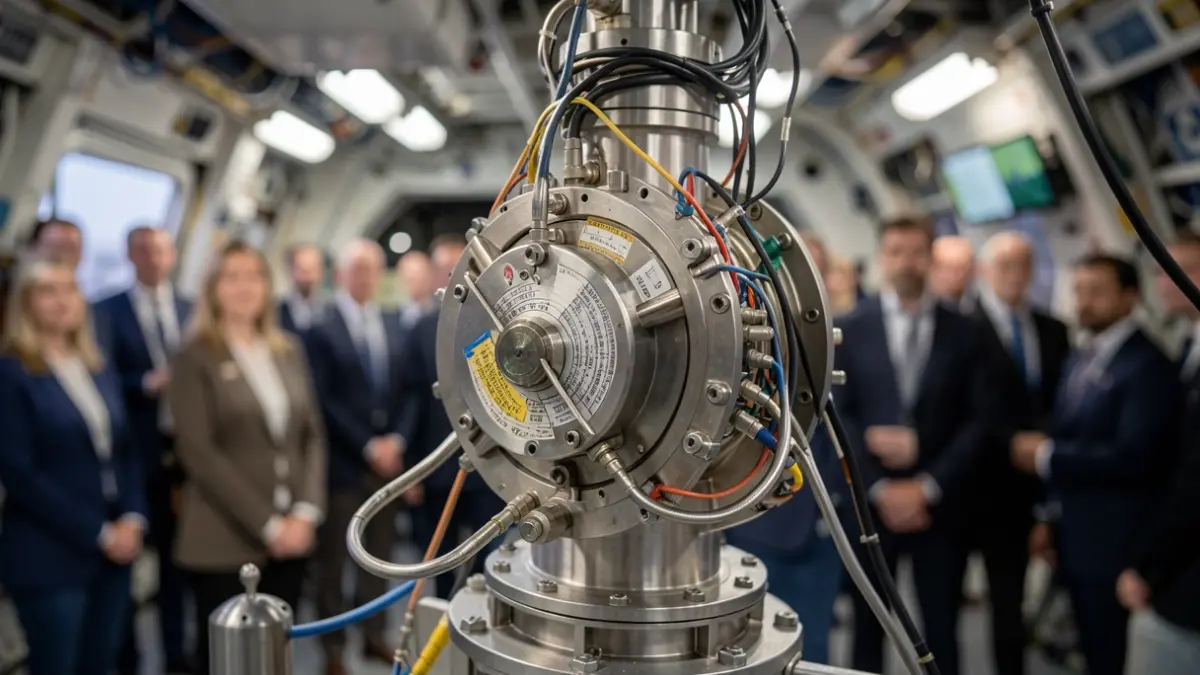
The award, presented by the British Interplanetary Society and the Arthur C. Clarke Foundation at a ceremony at the RAF Club in London on 27 October, recognises the scientific and engineering achievements behind the instrument designed to investigate the magnetic environment surrounding a comet.
Led by Professor Marina Galand from Imperial’s Department of Physics, the team includes Instrument Manager Emanuele Cupido, Engineering Lead Chris Carr, and Instrument Engineer Dr Irene Ruiz Rodriguez. They collaborate closely with the Space Research Institute (IWF) of the Austrian Academy of Sciences, a key contributor to the instrument's hardware.
The B2 magnetometer sensors were successfully integrated onto the B2 probe by Spanish contractor Sener Aeroespacial in July 2026. The spacecraft is now undergoing testing before integration onto spacecraft A, with a major campaign planned for next spring to characterise its magnetic environment.
Comet Interceptor, an ESA-led mission, aims to study a pristine comet or interstellar object entering the inner Solar System. It will deploy three spacecraft, including one from the Japan Aerospace Exploration Agency (JAXA), to observe the target simultaneously from different vantage points. The magnetometer is the only instrument flying across all three spacecraft, enabling coordinated magnetic field measurements.
The Imperial team has worked with partner magnetometer teams at TU Braunschweig in Germany and Kyoto University in Japan, conducting joint calibration campaigns and coordinating scientific operations. They are also analysing data from previous comet missions like Giotto and Rosetta to prepare for the Comet Interceptor encounter.
“"I am delighted for the team, who have been working extremely hard under a tight schedule and constrained budget in line with the nature of Comet Interceptor, ESA’s first F-class mission. The award acknowledges UK science leadership achieved through international teamwork."
“"This extremely fruitful and synergistic collaboration has led to the successful design and building of the flight instrument, and is continuing through the upcoming test campaigns and future operations."