University of Manchester Secures Three Major European Research Grants
Prestigious grants will fund pioneering research in ovarian cancer prevention, collagen-linked diseases, and sustainable computing.
By Liam Garside
••3 min read
AI
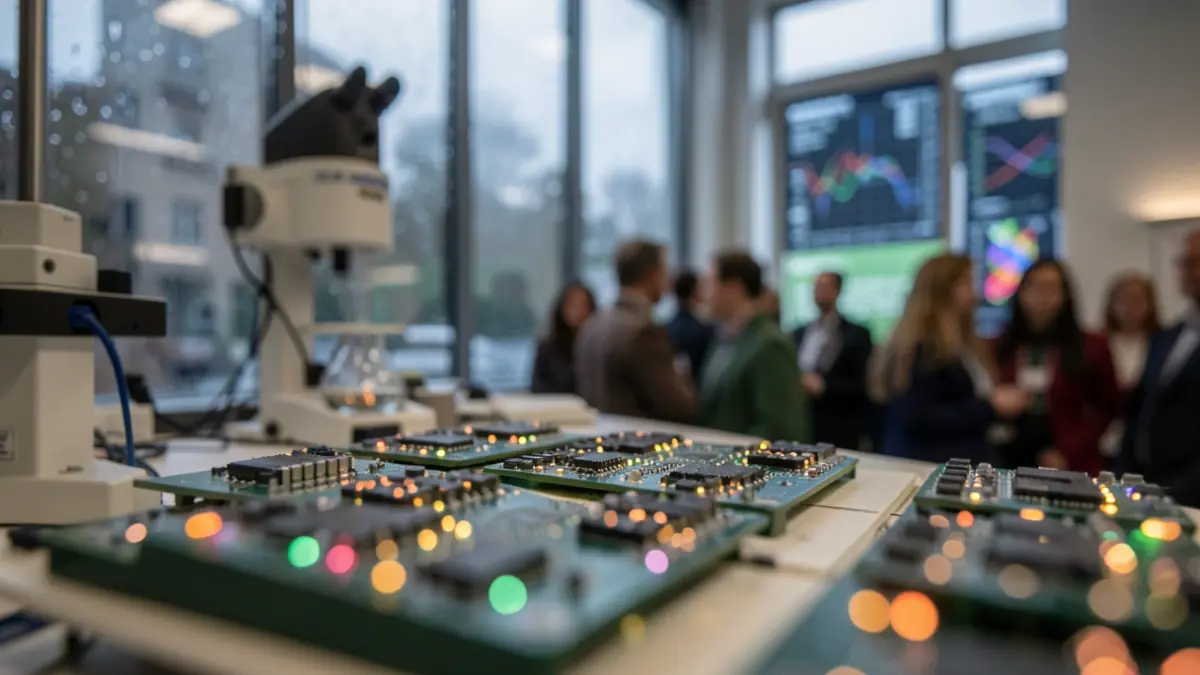
Generic image of tiny programmable devices with intricate circuitry, against a blurred background of scientific equipment and data visualizations.
The University of Manchester has secured three prestigious European Research Council Synergy Grants, totalling €17.1 million, to advance pioneering research in ovarian cancer prevention, collagen-linked diseases, and sustainable computing.
The six-year projects will focus on developing tiny programmable devices to detect and destroy precancerous cells, investigating the chemical structure of collagens and disruptions to this process, and creating faster, more energy-efficient computational methods for science and AI. These awards are part of 48 ERC Synergy Grants, worth €500 million, announced under the European Union’s Horizon Europe programme.
The ECLIPSE project, receiving €10.6 million, aims to explore whether small programmable devices, known as morphobots, can identify and eliminate precancerous cells that lead to ovarian cancer. These devices are designed to navigate the fallopian tubes, detect early changes, and deliver drugs directly to affected cells, potentially offering an alternative to preventative surgery. The project involves Principal Investigators Dr Christine K. Schmidt and Prof. Richard J. Edmondson from The University of Manchester, Prof. Ben G. Davis from the University of Oxford, and Prof. Oliver G. Schmidt at Chemnitz University of Technology. Manchester will receive approximately €4.3 million of the funding.
“
"We now know that many ovarian cancers begin in the fallopian tubes, but detecting the earliest precancerous changes remains a major challenge. ECLIPSE brings together expertise from very different scientific disciplines to develop entirely new ways of finding and targeting these cells. Our ultimate ambition is to intercept ovarian cancer before it progresses to a stage where treatment is often no longer curative."
The RaMPA project, awarded €10 million, will re-evaluate the use of numerical precision in scientific computing. Led by Professors Françoise Tisseur and Jack Dongarra at Manchester, alongside Professor Laura Grigori at EPFL and the Paul Scherrer Institute, and Professor Torsten Hoefler at ETH Zurich, the team will develop new algorithms and software to adapt precision during computations while ensuring accuracy. This will enhance the speed and energy efficiency of scientific simulations.
“
"By making much better use of the computing power available to us, we want scientists to tackle problems that are currently beyond reach, from more detailed climate simulations to increasingly complex questions in materials science and quantum chemistry, while reducing the energy needed to do so. The strength of RaMPA is that it brings together expertise in numerical mathematics, algorithms, software and computer systems. Combining these areas gives us the opportunity to rethink how scientific computations are performed, rather than simply making existing methods faster."
The €2.5 million CollagenQUEST project will investigate the link between collagen production and kidney and bone diseases. This collaboration involves Professor Rachel Lennon, Dr Joan Chang, and Dr Mychel Morais from Manchester, along with researchers from Finland, Italy, and the USA. The team will combine expertise in basement membranes, collagen production, computing, and mass spectrometry to understand how cellular changes impact tissues and patients.
“
"Joan, Mychel and I want to connect what happens inside a cell with what it means for a whole tissue — and ultimately for patients. Our partners bring the expertise needed to understand the enzymes, molecular structures and cellular processes behind those changes. The strength of CollagenQUEST is that we can follow a question from patient genetics to a molecular experiment and back into living cells and tissues. That is how we can tackle a problem none of our teams could solve alone."
ERC President Prof. Maria Leptin commented that the Synergy Grants enable exceptional researchers to combine diverse approaches and pursue ambitious ideas. The selected teams are noted for their creativity in exploring uncharted scientific territory.